
The root: where everything begins
The root system determines final yield
When a grower thinks about production, they usually imagine dense flowers, intense aromas and heavy buds at the end of the cycle. But reality is much quieter and happens out of sight. True yield is decided beneath the substrate, and it begins during the first days of life, when the plant is still a fragile, inconspicuous seedling.
At that moment, the plant is not growing upwards. It is growing downwards. Every millimetre of root that advances through the substrate is a promise of future absorption, vigour, resistance and production. The root is the invisible infrastructure of the crop. Without a solid base, it does not matter how much light, fertiliser or technology is applied afterwards: the plant will never reach its full potential. This demonstrates something very important: the visible part of a plant is always in balance with the part that is not visible.
In indoor growing, where every parameter is controlled with precision, the root becomes even more important. It is the organ that connects the plant with its environment. Through it enter the water, nutrients and oxygen that will sustain the entire metabolism for weeks.
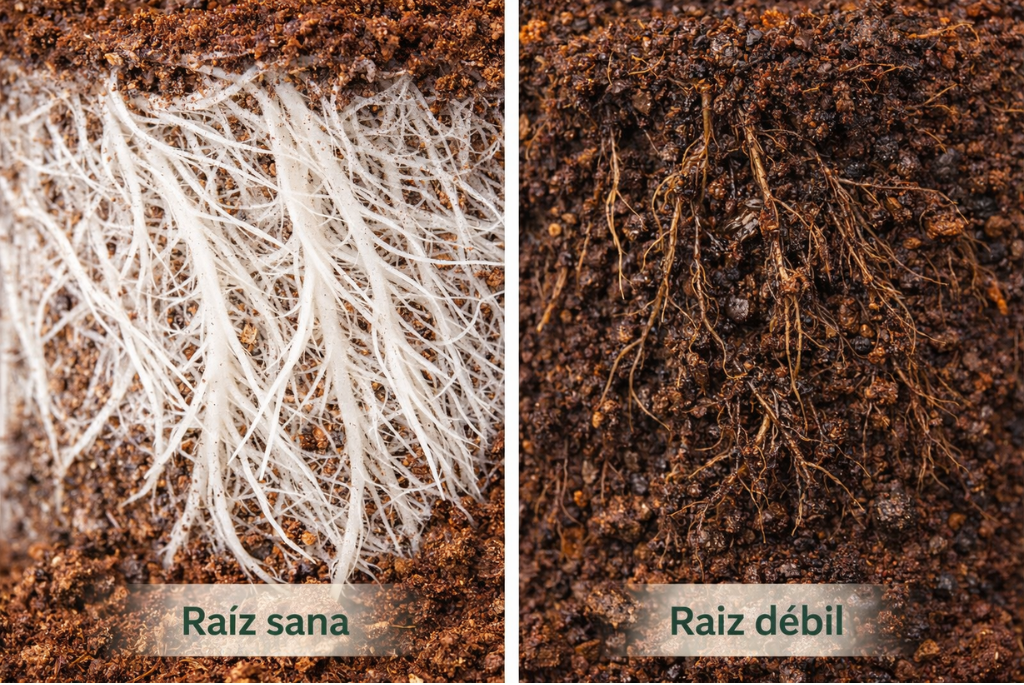
A healthy root does not only feed the plant. It gives it stability, growth speed and the ability to withstand stress. A weak root, on the other hand, turns any small mistake into a visible problem: pale leaves, slow growth, nutritional lockouts or unproductive structures.
That is why the first days of cultivation are not a secondary phase. They are the true starting point of final yield.
First days of cultivation: root development
During germination and the first weeks of growth, the plant devotes itself almost exclusively to forming its root system. First the main root appears, anchoring the plant to the substrate. Then the secondary roots and root hairs develop, microscopic structures responsible for absorption.
This process is decisive. A well-formed root allows the plant to explore the substrate efficiently, find water and nutrients easily and maintain steady growth. If, on the other hand, the root environment is unstable, development slows from the very beginning.
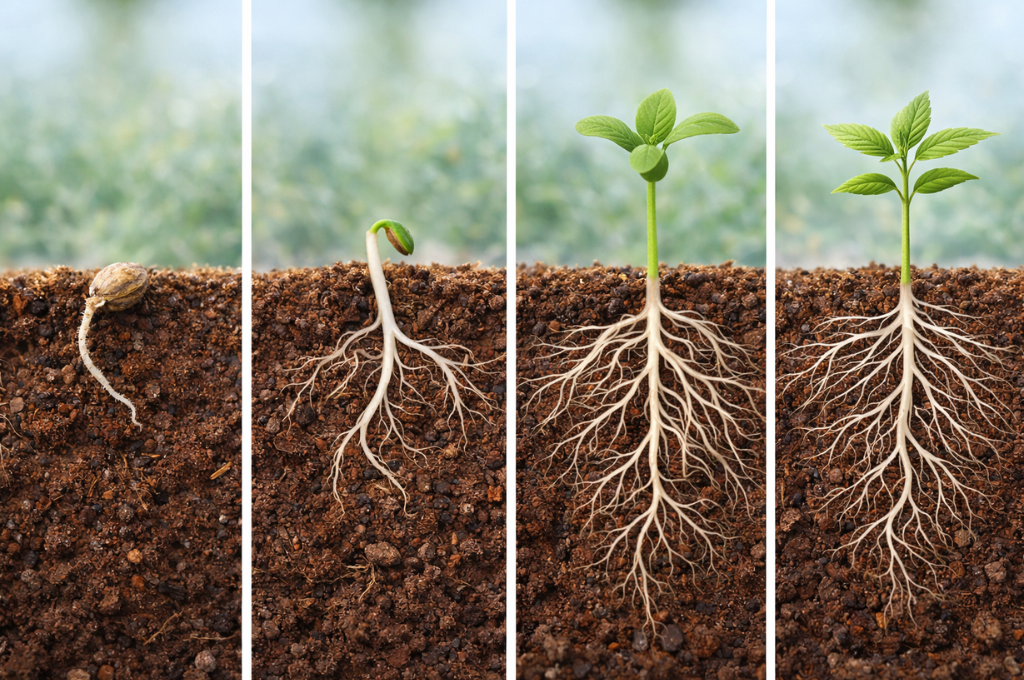
Factors such as an incorrect pH, a poorly aerated substrate or unbalanced nutrition can limit root growth without the grower noticing immediately. The problem appears later, when the plant should be growing strongly and simply does not respond.
In systems such as coco or hydroponics, this is even more pronounced than in soil, since nutrition is fully controlled and the root system becomes the absolute centre of the whole process. A well-nourished and oxygenated root is able to absorb quickly, keep the metabolism active and sustain vigorous growth under LED lighting.
That is why, from the first weeks, it is essential to offer the plant a stable environment and balanced nutrition that favours root development. When the root receives the right elements at the right moment, the plant responds with a stronger structure, healthier leaves and more uniform growth.
It is silent, almost invisible work, but decisive. Because everything that happens during flowering will depend on what the root built during these first stages.
Conclusion
Yield does not start at flowering. It starts at the root.
A plant with a strong root system absorbs better, grows faster and better withstands any cultivation stress. This makes it possible to tackle the following crop phases successfully, from vegetative growth to flowering.
A weak root, by contrast, limits the plant's potential from the start.
Everything the grower does during the first weeks —pH, watering, substrate oxygenation or initial nutrition— will have a direct impact on final production.
Final tips
- Keep the pH stable from the first watering, especially in coco or hydroponics.
- Avoid excess water at the start: roots need oxygen as much as moisture.
- Use a light, aerated substrate that allows root expansion.
- Start with gentle but complete nutrition, adapted to the early phases.
- Watch the growth rate: a seedling that advances quickly is the result of a firm, healthy root that is well established and developed.