Reinforcement & resistance
Silicon
Silicon (Si) makes up 28% of the earth's crust and is the second most abundant element after oxygen. There is not enough scientific confirmation to consider it an essential element for all plants—despite being a constant and notably abundant component in plants—but its beneficial role in every crop is clear. The plant takes it from the soil solution, although it cannot always absorb it in the required amounts and, in soilless growing systems (hydroponic or substrate-based), it is often deficient.
Its beneficial effect lies in the partial substitution of P and B, in addition to other mechanical and physiological functions of great importance for the crop: it regulates the plant's transpiration flow; releases phosphorus from the soil's adsorbed fraction; improves the uptake of nitrogen and all other nutrients; increases tolerance to excesses (Mn, Fe and Al in acidic soils or substrates) and to salinity; promotes the growth and strengthening of roots and stems, which stay erect, thicker and less prone to bending or falling; increases mechanical resistance by reinforcing cell walls and controlling water loss from the plant's surface; provides greater resistance to fungi and insects; improves tolerance to drought, excess heat, low temperatures or wind; and increases the filling and weight of flowers and fruits, improving the quantity and quality of the harvest as well as resin content.
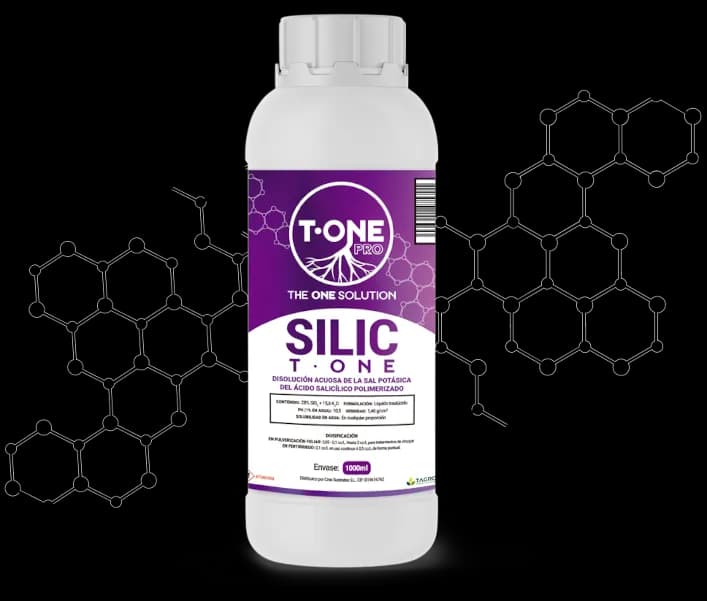
Dosage: as a foliar spray, 0.05-0.1 cc/L (up to 2 cc/L for shock treatments); in fertigation, 0.1 cc/L for continuous use or 0.5 cc/L occasionally. Add it to the nutrient solution immediately before applying to avoid precipitation problems.
Application frequency: weekly or biweekly as a foliar spray or in occasional fertigation applications; it can also be used in continuous fertigation at the indicated dose. It does not cause phytotoxicity if the recommendations are followed.
Uses: suitable for any growing medium (soil, coco or hydroponics), for any type of crop (indoor or outdoor) and at all development stages, mainly from the growth stage through flowering.
Available formats
- 500 ml
- 1 L